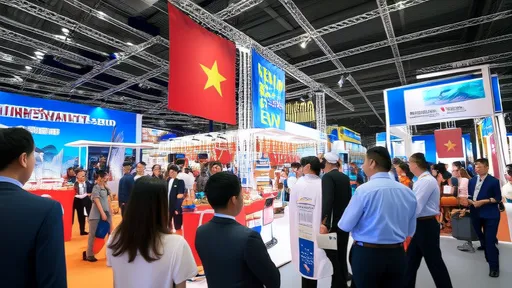
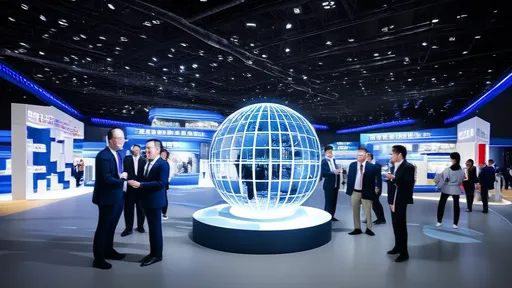
The sprawling exhibition halls of the China International Import Expo (CIIE) in Shanghai have transformed into more than just a marketplace for global goods; they have evolved into a dynamic, real-world laboratory where the future of industry is being stress-tested before a global audience. This year's event has firmly established itself as the world's premier testing ground for innovation, with two technological frontiers—low-altitude economy and artificial intelligence—emerging not as distant concepts, but as tangible, integrated systems poised to redefine our economic and social fabric.
The unmistakable buzz at the Expo is no longer just the sound of commerce. It is the literal hum of electric vertical take-off and landing aircraft (eVTOLs), the quiet whir of advanced delivery drones, and the animated discussions about AI agents managing complex urban systems. What sets this exhibition apart is its move beyond speculative theory. Companies are not merely displaying prototypes; they are demonstrating functional ecosystems. Visitors can witness a drone deliver a medical sample from a simulated urban rooftop to a hospital lab, while an AI system simultaneously analyzes the data, predicts traffic for the drone's route, and coordinates with ground-based autonomous vehicles. This is innovation in context, a vision of a synchronized technological future unfolding in real-time.
The Sky is No Longer the Limit: The Dawn of the Low-Altitude Economy
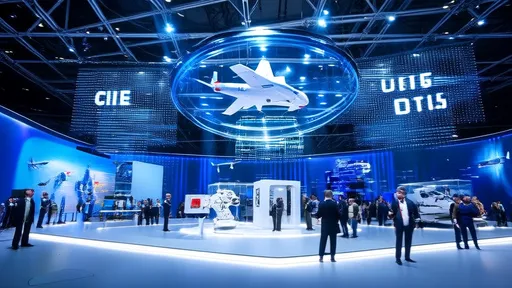
The concept of utilizing the airspace just above our heads is rapidly crystallizing into a full-fledged economic sector. The low-altitude economy, encompassing everything from passenger air taxis and logistics drones to aerial surveying and urban air mobility, has taken center stage at the CIIE. The progress is palpable. Whereas previous years featured scale models and promotional videos, this year's Expo showcases airworthiness-certified eVTOLs from companies like EHang and AutoFlight, with some models having already completed demonstration flights in cities across China and the Middle East.
The significance lies in the demonstrated maturation of the entire value chain. It's not just about the aircraft themselves. Exhibitors are presenting the critical enabling infrastructure: compact vertiports designed for integration into urban landscapes, advanced air traffic management systems that can handle hundreds of simultaneous low-altitude flights, and rapid-charging stations specifically engineered for aviation batteries. "We are moving from proving the technology to building the ecosystem," commented a senior engineer from a leading aviation firm. "The CIIE allows us to show potential city planners and investors that this is not science fiction. The hardware, the software, and the operational protocols are here, now."
Furthermore, the applications on display are strikingly practical and diverse. Beyond the glamour of air taxis, heavy-lift drones are demonstrated for agricultural spraying and firefighting, while smaller, nimble drones are shown performing tasks like infrastructure inspection and emergency response. This practical focus underscores a key trend: the low-altitude economy is being built from the ground up, targeting specific industry pain points with viable, economically sound solutions.
The Invisible Architect: AI Weaves the Fabric of Future Industries
If the low-altitude economy represents the new physical layer of commerce, then artificial intelligence is the omnipresent, intelligent nervous system controlling it. The narrative around AI at the CIIE has decisively shifted from standalone applications to pervasive, foundational intelligence. The most compelling demonstrations are those where AI operates in the background, orchestrating complex processes seamlessly.
In the smart manufacturing section, entire production lines are run by AI systems that perform predictive maintenance, self-optimize for energy efficiency, and dynamically adjust production schedules based on real-time global supply chain data. The AI doesn't just control machines; it manages the entire logistical and economic equation. Similarly, in the healthcare pavilion, diagnostic AI is integrated with robotic surgery systems and hospital management platforms, creating a continuous loop of data that improves patient outcomes and operational efficiency simultaneously.
A particularly striking development is the emergence of AI "agents" or "copilots" designed for specific industries. These are not general-purpose chatbots, but deeply specialized digital entities. An AI copilot for a farmer can analyze satellite imagery, soil sensor data, and weather forecasts to provide hyper-specific instructions on irrigation and harvesting. Another, designed for a financial analyst, can traverse global markets, regulatory documents, and news streams to generate nuanced investment theses. This represents a maturation of AI from a tool to a collaborative partner, capable of shouldering complex cognitive workloads.
The underlying hardware powering this AI revolution is also on full display, with Chinese and international chipmakers unveiling next-generation processors designed not for raw computing power alone, but for extreme energy efficiency, enabling the widespread deployment of advanced AI at the network's edge—in phones, cars, and sensors everywhere.
The Confluence: Where Drones Meet Data
The most profound insights from the CIIE emerge at the intersection of these two domains. The low-altitude economy generates a torrent of real-world data—terrain, weather, object recognition, traffic patterns. AI, in turn, is the only technology capable of processing this data deluge to make autonomous, split-second decisions. This symbiotic relationship is the engine of the future.
Consider an urban air mobility network. An eVTOL doesn't just fly a pre-programmed route. Its flight path is constantly recalculated by a distributed AI that incorporates live data from other aircraft, weather sensors, and ground traffic. If an emergency vehicle is detected on a road below, the AI might subtly adjust the flight paths of a dozen drones in the vicinity to minimize noise disruption. This is a level of dynamic, large-scale coordination that is impossible for human operators alone.
This convergence is also accelerating the pace of innovation itself. The data collected from thousands of drone flights is used to train even better AI models for navigation and obstacle avoidance, creating a virtuous cycle of improvement. The physical world becomes a data-generating engine, and the digital AI mind becomes smarter with every flight, every delivery, and every inspection.
A Global Stage for a Shared Future
The CIIE's role as a global innovation test bed is crucial. It provides a neutral, collaborative platform where international companies can showcase their technologies alongside Chinese partners, fostering cross-pollination of ideas. European sensor manufacturers find their components in Chinese drones; American AI software is integrated into Asian manufacturing robots. The Expo demonstrates that the future being built is not a siloed one, but a deeply interconnected global project.
The message from the bustling floors of the National Exhibition and Convention Center is clear: the future is not a single technology, but a fusion. It is a future where the sky hums with intelligent electric aircraft, all guided by an invisible layer of artificial intelligence that makes the entire system safe, efficient, and scalable. The CIIE has successfully moved these concepts from the whiteboard to the real world, proving that the next industrial revolution will not be born in a secret lab, but tested, refined, and scaled on a global stage, for all to see and participate in. The trial runs are over; the implementation has begun.

By /Nov 4, 2025

By /Nov 4, 2025
By /Nov 4, 2025

By /Nov 4, 2025
By /Nov 4, 2025

By /Nov 4, 2025

By /Nov 4, 2025

By /Nov 4, 2025
By /Nov 4, 2025
By /Nov 4, 2025
By /Nov 4, 2025

By /Nov 4, 2025

By /Nov 4, 2025

By /Nov 4, 2025

By /Nov 4, 2025

By /Nov 4, 2025

By /Nov 4, 2025

By /Nov 4, 2025

By /Nov 4, 2025

By /Nov 4, 2025